Films made about famous people are nothing new, but it does seem a little odd to me that a film about someone as iconic as Alfred Hitchcock took over 30 years after his death to get made, whereas Chris Kyle of American Sniper only had to wait less than two years after his death. I know the two don’t have any common ground except for focusing on someone well-known, it’s just a little food for thought.
Sacha Gervasi had the task of bringing the esteemed director’s story to life. Well, it shouldn’t be too hard, he only made a host of classic films and gained the nickname the Master of Suspense. So, no pressure then.
The film begins with Alfred Hitchcock (Anthony Hopkins) introducing the film to the audience in a style reminiscent of his TV show Alfred Hitchcock Presents, and with Ed Gein (Michael Wincott) killing his brother to kick things off, we are thrown right into the narrative with very little time wasted.
Hitchcock, along with his wife and long-time collaborator Alma Reville (Helen Mirren), are being hounded by the press while leaving a showing of North By Northwest. A report suggests to Hitchcock that as he is now sixty, he should just quit. He doesn’t respond and instead goes on the hunt for a new project. He turns down an adaptation of The Diary of Anne Frank as well as a chance to film Casino Royale. He wants something different that he feels he has never done before, which he seems to find in the novel Psycho written by Robert Bloch and influenced by the Ed Gein murders. He informs his wife and friends of his intentions, as well as the people that run the studio and will be held to account if it fails. Needless to say, they are less than enthusiastic about the idea.
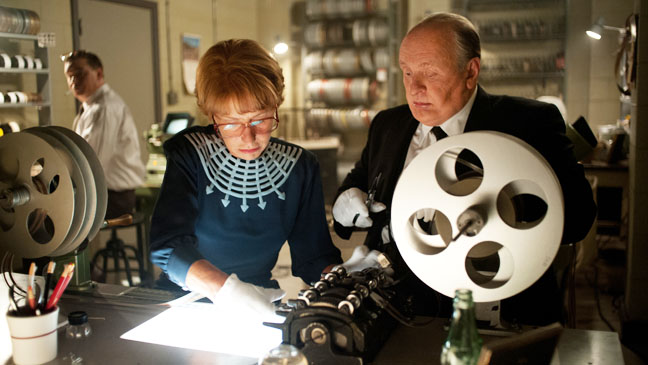
With some help from a ‘fat suit’, Hopkins pretty much becomes Hitchcock. He makes a creditable job of Hitch’s slow, lugubrious way of speaking, as well as some of his mannerisms. He also conveys well the director’s determination in his creative pursuits. Reville is also well portrayed by Mirren. She plays the role of devoted wife very well but also shows great talent in a scene where she and Hopkins have an argument which, if it really happened, was likely the result of her living in the shadow of a much more famous husband. Scarlett Johansson plays Janet Leigh very well but some other people important to the story such as Anthony Perkins (James D’Arcy), Vera Miles (Jessica Biel) and Hitchcock’s personal sectary Peggy Robertson (Toni Collette) fade into the background. Michael Stuhlberg and Kurtwood Smith turn in rather one-note performances as Hitchcock’s agent Lew Wasserman and studio censor Geoffrey Shurlock respectively.
There are some stronger elements in the supporting cast, such as Danny Huston as the noted screenwriter Whitfield Cook. Wincott is passable enough as Gein. Ralph Macchio also makes an appearance as writer Joseph Stefano, but he’s easily forgettable.
The book Alfred Hitchcock and the Making of Psycho is credited as the basis for the script, but all I can see is that John J. McLaughlin has stuck to one of the many biopic formulas: the main character wants to make something so badly that he will risk everything, including his reputation and his personal fortune. Most people close to him are not up for it but come around in time. To give Reville something to do, she starts collaborating on a script with Whitfield Cook, but the audience and Hitchcock are led to believe that this is actually an affair. Also, Gein suddenly starts appearing in several of Hitchcock’s fantasies that are not limited to him thinking about stabbing anyone he sees as an obscuration in his work. An interesting idea, but it just feels out of place with the rest of the film.
The look of the late 50s to early 60s is believable enough if a bit generic. The makeup efforts of getting actors to look like their characters as much as they can is certainly something I can commend. Hopkins and Johansson could fool you momentarily into thinking they’re the real Hitchcock and Leigh. Wincott also looks very much like Gein.
Danny Elfman has let me down with a bland score that I will likely forget about within the next few days, but it’s a great bonus to hear the theme of Alfred Hitchcock Presents in the opening and closing credits, as well Bernard Herrmann’s strings from the shower scene; memorably, Hitchcock is seen pretending to conduct this (as well as ‘conducting’ the audience’s reactions) while secretively watching the first screening from the cinema lobby.
The films runs for less than two hours, but drags a little in places and the dream sequences seemed jarring to me. When a crow lands on Hitchcock’s shoulder, I really hoped it wasn’t a hint that there might be a further film focusing on The Birds. It’s good to see Hitchcock finally brought to screen, but once is enough.
If you are a long-time Hitchcock fan you will undoubtedly be pleased with what you see here. There are a lot of good performances, but if you can’t bear to sit through another formulaic biopic with all the clichés you can think of, then you should maybe avoid it. Don’t get me wrong, I liked it, just a lot less than I thought I might. I guess Norman Bates may have been on to something – I guess we all do go a little mad sometimes.