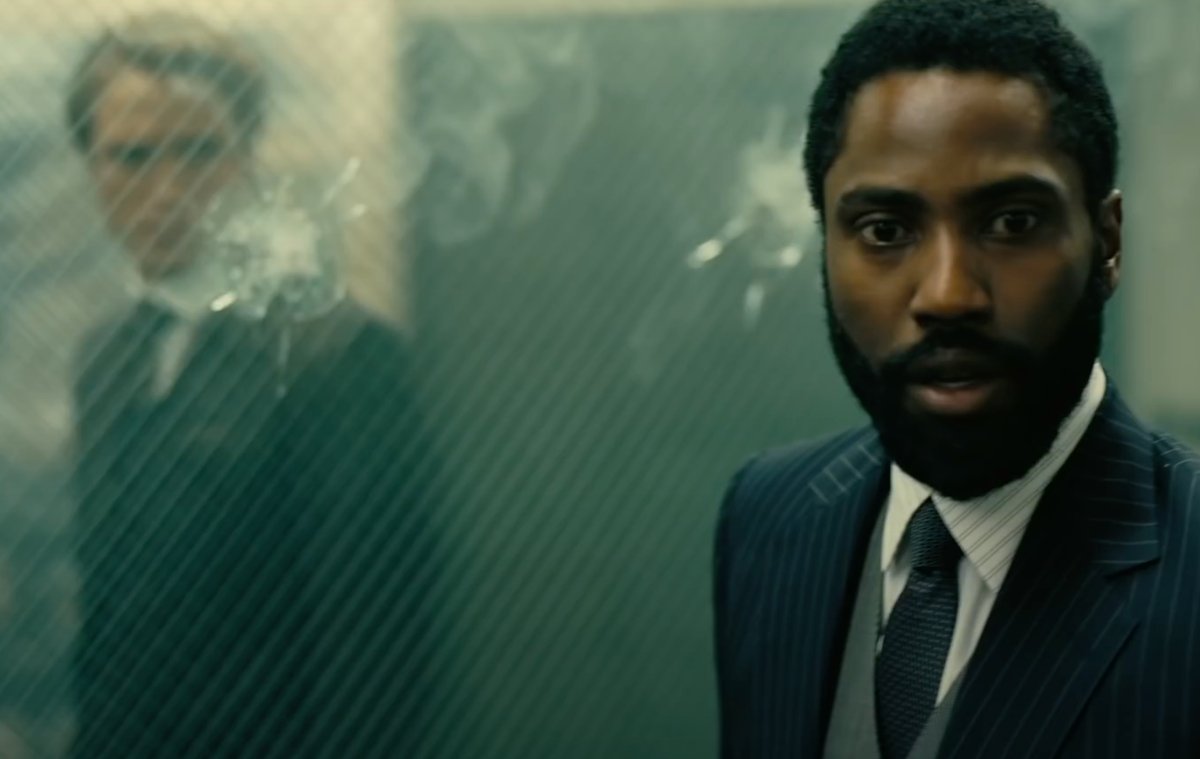
Tenet is the latest film from director Christopher Nolan and is more than likely destined to become known as the first new cinema release post-lockdown. The advertising seemed to keep things vague – I didn’t come across much of it. But from what I gathered, Nolan was directing, and John David Washington and Robert Pattinson were among the leading cast, along with previous Nolan collaborators Michael Caine and Kenneth Branagh (I’m going to keep this as spoiler-free as I possibly can).
The plot concerns two secret agents, apparently named The Protagonist and The Protagonist’s Handler (played by Washington and Pattinson), as they go on a mission to prevent the possibility of nuclear war, while also having the ability to “bend time.” And somehow an abusive arms-dealing husband (Branagh) and his long-suffering wife (Elizabeth Debicki) are involved, where everything might not be as you would expect.
John David Washington gives another good performance to add to his growing filmography. He can play not only the calm, cool and collected spy, but also switch over to a more brutal personality when he needs to. He and Pattinson work well together and while I was prepared for the worst with Pattinson given his early work, he didn’t do anything mind-blowing, but was a likeable enough presence. Debecki plays the wife competently enough, but not in a way that hasn’t already been done by someone else, maybe better. Branagh slips into his villainous role quite well; he does some standard shouting and screaming but not to an extent that it becomes laughably over the top. I’m not actually sure what Branagh is better at, heroes or villains.
Michael Caine shows up early on and gives the usual overdone performance of ‘likeable old man in a Christopher Nolan film’. But like Pattinson his presence is still welcome.
As usual Nolan wrote the script, which he apparently developed over several years. He barely wastes a minute and before you know it, the first of many visceral action scenes has already begun. Don’t worry, though, there’s plenty of them to go around. Some scenes do get very talky, but you might as well listen to what’s being said in case you miss an important plot point. Apart from that, the film (mostly) feels fast-paced and not at all like two hours and thirty minutes.
Hoyte Van Hoytema provides the cinematography and this film does have quite a lot of memorable visuals. A very impressive one for me is a shot of the camera just panning across a desert where it’s nothing but explosions and chaos, along with a vehicle that may be going in an odd direction.
Moving onto the effects, the way the time-bending stuff occurs on screen is impressive, though the novelty does wear off once you’re desensitised to it. But it’s the one thing keeping this apart from your average spy film.
I would understand if you thought Hans Zimmer was composing the score – this time he’s not, those duties have been handed over to Ludwig Goransson who just uses a lot of the same loud horn sounds all the way through the film. If that’s what was required I’m sure Zimmer could have obliged, but I guess we will have to make do with Goransson as a substitute, even if he fails to bring the high quality of music that Zimmer is often associated with.
Like most of Nolan’s work two of his tropes often lead to less satisfying results. Tenet follows the pattern of dragging from time to time and being confusing in places. This is particularly true in the final act where there’s quite a lot going on and there seems to be no end in sight for a while. Also the outcome at the end of the film is rather ambiguous, but plot resolutions that don’t have definite answers is something that Nolan’s fans have come to expect from him and indulge him in. I’m just taking longer to adjust.
Tenet proves to be a worthwhile film to return to the cinema to see. There’s a lot to admire from the performances, with a generally fast pace that does its hardest to keep the story moving and the viewer interested. It can’t quite stop itself from succumbing to a climax that could have been made less protracted and a lot more coherent. But it’s worth going to see it on the big screen, just make you sure your attention is always on the film and obey whatever distancing guidelines the cinema has in place.
B-
Thank you for reading.