
A few years ago the documentary Spielberg gave viewers an insight into the life and career of one of the greatest film directors of all time. It showed his early life, his love of films and filmmaking and the situation with his family that led to his parents divorcing. That was the true account of his story and now with his latest film The Fablemans he is ready to tell the semi-autobiographical version. The screening I went to even had a short message from the man himself where he talked about how personal the film was and how much it meant to him that the audience had come to see it in a cinema on the big screen.
It all begins one night in January 1952 with Burt and Mitzi Fableman (Michelle Williams and Paul Dano) taking their son Sammy (Mateo Zoryan Francis-DeFord) on his first visit to the cinema to see The Greatest Show On Earth. He is nervous about it at first, but on seeing a scene involving a train crash it leaves him silent and awestruck at what he just witnessed. This leads to him having a compulsion to recreate the crash with his own model trains over and over again. Before much time has passed Mitzi gives him a camera to film the crash with and as he grows up he uses his camera to make silly films with his sisters and friends capturing moments with family and starts to dream about becoming a director. But then his camera gets hold of a huge, potentially devastating family secret which also goes on to be a big part of what dominates the film’s narrative.
As a director Spielberg is unquestionably versatile with many iconic films to his name like Jaws, ET, the Indiana Jones films, Schindler’s List and many others. He can do character-driven drama just as well as films that are more centred around sci-fi and action. Anyone could have chosen to come up with a film about a family like this and the love of film but with Spielberg’s name attached to it there is a sense of expecting something of a higher calibre regardless of how formulaic and predicable it might be.
The term all-star cast definitely applies here. Williams and Dano are very good as the parents. Williams is perfectly believable as a lively and loving mother who appears to just endlessly enjoy herself, even if there is another side to her. Dano comes across as a father who is supportive but also not entirely as understanding of his son’s ambitions as his wife. But even that doesn’t entirely destroy the character’s likeability.
The supporting cast is also surprisingly strong. Seth Rogen plays a family friend and I didn’t even realise it was him at first, even more surprising was that he was actually somewhat entertaining without being crude or raunchy and for him that certainly feels refreshing. Judd Hirsch shows up for one scene as Sammy’s grand-uncle Boris who he has a passion-fuelled rant with him about art, pursuing dreams and what it will potentially do to him as well as his family. There has been some talk about the climax of the film when Sammy goes to see a director he idolises, this being John Ford who is played here by fellow director David Lynch. I don’t know if Ford really was larger than life as Lynch’s portrayal would suggest, but when someone is on screen for such a short period of time it’s remarkable that he leaves such a strong impression when the credits started rolling.
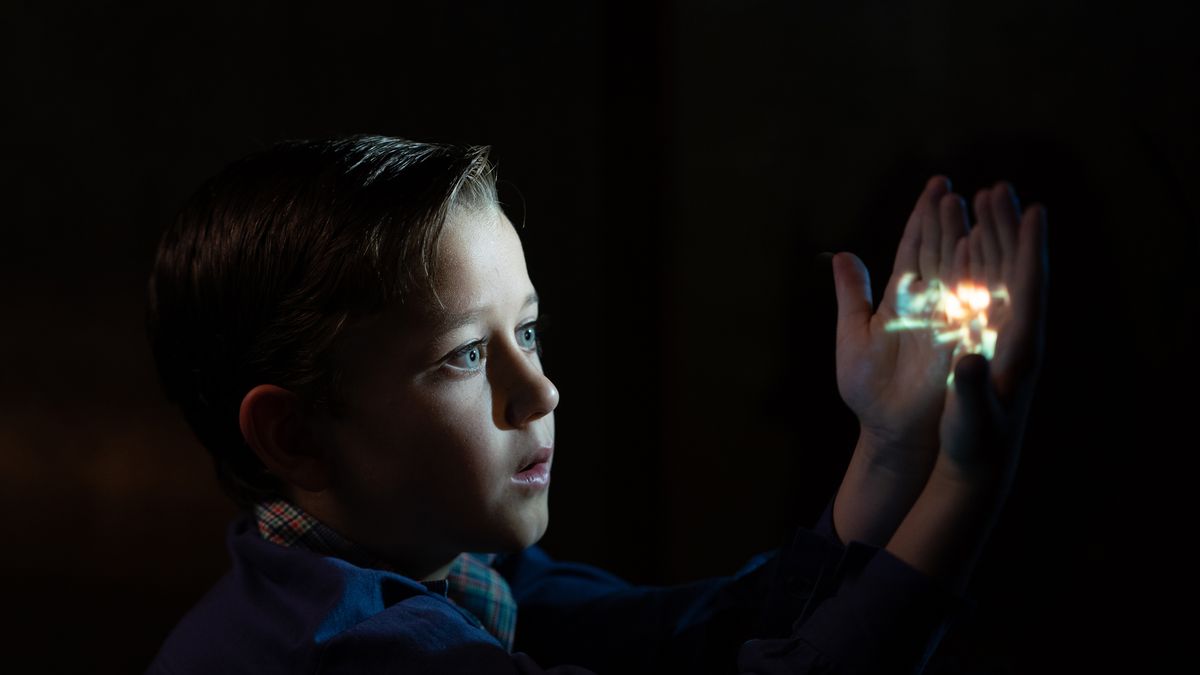
I realise I’ve mentioned the character of Sammy without actually talking about him. Zoryan Francis-DeFord may get to be in the film’s iconic images, like the one of him practically holding the film of his train crash in his hands as well as the image of his eyes looking perfectly entranced gazing at the cinema screen. But in the end it’s Gabriel LaBelle as the teenage and young adult Sammy who is on screen for the majority of the runtime. He’s capable in the role, but it does feel like he’s really the only one giving a clichéd performance. It might not be as much his fault as the material he has work with. He hits all the right, familiar beats but some of the more experienced actors seem like they are giving a little more to it than the actual leading actor.
This is of course based on Spielberg’s own life, so it only makes sense that he would write the script (along with Tony Kushner). A major risk of adapting your own life story is in making it too sentimental and wallowing in nostalgia. Spielberg could have chosen to have made this all about the dream of directing and what he can do with the camera. While that is there, he also takes time to examine the slowly-decaying relationship with his parents and the effect it has on them as well as his fictional stand-in. I’m pleased to say that sentimentality definitely didn’t appear to be driving force.
There are a lot of films with similar plots where someone wants to pursue a dream and their parents won’t let them do it. The really strong point of this script is its characterisation, especially of the parents. It would have been way too easy for them to be vilified and clichéd but they are not. They are well acted and well written as people who love each other but can’t get past certain obstacles in their relationship. There’s also a moment where Sammy is called out for selfishly pursuing his dream while the family falls apart, and while it is another familiar story beat it shows just how important this all is to him as it must have been to the young Spielberg himself.
I will admit that I was surprised at just how invested I became in the story and its characters, even if what happened in real life already told me where it would end up. It does have a long runtime of just over two and half hours, but it never felt that long at all. Something was always happening even if It wasn’t anything mind-blowing or exciting. But I do have to say that it did end abruptly with the sense that there was going to be a little more to come, but there wasn’t.
I mentioned the Spielberg documentary and some things that featured in it did indeed happen and have worked their way into The Fablemans. Spielberg did film his mother on a tree, he did make short films while he was a teenage boy scout, he was bullied as a teenager and as hard as it may be to believe, his family did at one point own a monkey. The documentary is long, in fact I think it’s just as long as this film, but if you know what to look for, it’s interesting to note what elements were without a doubt real. I don’t know too much about Spielberg’s life outside of it. I’m sure some of what is in the film has been made up or embellished, but I couldn’t possibly pinpoint it the way I could with what was in the documentary.
Frequent Spielberg collaborator, cinematographer Janusz Kamiński is of course responsible for the film’s imagery which includes the ones I mentioned earlier. Everything seems as well handled as someone with Kaminski’s experience could possibly make it, and also includes a notable sequence of Williams dancing in front of some headlights.
It almost wouldn’t be a Spielberg film without a score by John Williams. The piano seems to be at the centre of things but it’s hard to really give it all your attention with the focus really being what is on screen. I think it would be better enjoyed in soundtrack form, but Spielberg and Williams have always proven to be a winning combination and I’m sure that given the right time and circumstances I would come to think the same of what was composed here. There are a few songs from the early sixties but they only have one simple thing to do, evoke the period – which I would like to think they do, but none feature long enough for me to make a definite decision as to whether or not they work.
To make a film of his childhood and his family has been a long-held ambition for Spielberg as far back as the 1990s and with The Fablemans he has brought that idea to life. The performances, script and cinematography all have something worthwhile to bring and its message of having artistic dreams that the people around you don’t appear to understand, should resonate with people who have similar dreams.
I have no idea what Spielberg will do before he has to put his camera down for good and while he may be forever associated with flying bikes, whip-wielding professors and sharks, this is certainly a worthy addition to the filmography of a legendary figure in cinema. I look forward to what Spielberg does next. I just hope he doesn’t dare put any of his childhood bullies in it.
1 Comment
Adelaide Dupont
Hi Andrew,
hadn’t even realised there was a documentary that spielberg made himself!
That moment with the electric trains where he kept rewriting the narrative.
It made me think of either A GOOD PERSON or BEAU IS AFRAID [the latter they think is strongly autobiographical of its director’s experience even though there’s nothing in there that is explicitly his].