
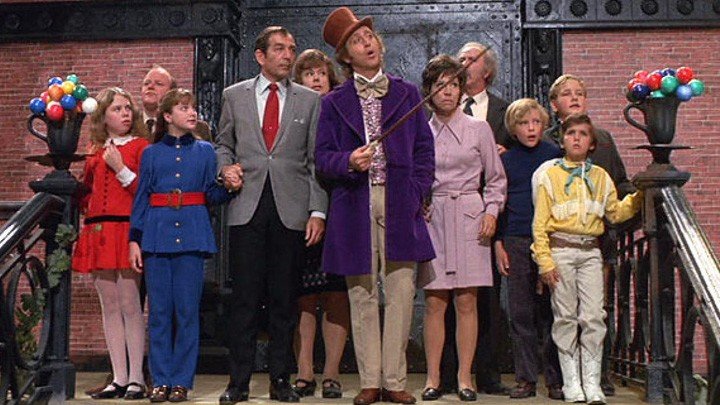
I make no effort to hide my admiration for Charlie And The Chocolate Factory – after all, it was the first film I ever saw in the cinema. Growing up I became aware of the better-regarded original from 1971, Willy Wonka And The Chocolate Factory. It was more of a musical than the remake, which was probably one of the reasons I didn’t bother with it; I did have a copy recorded off the TV but left it unwatched for years. That has now changed and I’ve seen the film all the way through for the first time, so now I can talk about it objectively.
Directed by Mel Stuart and obviously based on the book (actually called Charlie And The Chocolate Factory), this is a film that still gets a lot of attention fifty years later. It’s been parodied for as long as it’s existed, and pictures taken from the film have been used to make internet memes. It may not be the best or most understandable thing to do with a film like this but the continuing attention that comes from it can only be a good thing.
I wonder if I really have to discuss the plot in any detail at all… but I’m still going to anyway. The film of course centres on a poor boy named Charlie Bucket (Peter Ostrum) who lives with his mum and four grandparents and lives on cabbage soup. But when it’s announced that five golden tickets have been put in Wonka Bars and could be anywhere, the world seems to go crazy doing whatever it takes to find one. They are all eventually found by kids with names like Augustus Gloop (Michael Bollner), Veruca Salt (Julie Dawn Cole), Violet Beauregarde (Denise Nickerson), Mike Teavee (Paris Themmen) and of course Charlie. Now they get to visit the factory and meet the reclusive genius Willy Wonka (Gene Wilder) with the promise of a special reward at the end.
Let’s get the obvious out of the way, for just about anyone Gene Wilder is and always will be Willy Wonka and it’s not difficult to see why. He’s easily likeable and gives the role everything he’s got. Even when the kids are in danger you can’t help but find it amusing at how little he seems to care, and for the few times he raises his voice, especially in the famous tunnel scene, it does feel a little surprising given how calm he was just seconds earlier. It’s definitely a good performance but I think it would be a little unfair to try to compare him with Johnny Depp’s portrayal, given how different they are. In fact you could say the same about any of the main cast.
This was Peter Ostrum’s one and only performance in a film and with that in mind he didn’t do too badly here. He’s got Charlie’s good nature but he’s also not above coming across as greedy or enjoying doing something that he knows is wrong. I’m not too sure what the intended approach was to the character, but if it was meant to be realistic then I think it paid off. Which is more than I can say for the rest of the kids, who all come across as stereotypes. They do what the role asks of them but I do sometimes wonder if Julie Dawn Cole played Veruca a little too well to the point where she maybe became a little unlikeable.
Most of the adults are played by not-especially-famous character actors like Leonard Stone as Mr Beauregarde and Roy Kinnear as Mr Salt. The only ones who leave any kind of impression are Diane Sowle as Mrs Bucket and Jack Albertson as Grandpa Joe. Sowle just plays a clichéd caring mom role who’s only notable because of a song which I will come to later. Albertson works well with Ostrum and the chemistry between the two is very believable.
Roald Dahl is credited with writing the script but he ended up disowning the project, and most of what is on screen would appear to be rewrites by David Seltzer. The basic plot seems to be intact – I can’t be as certain as I would like to be about what was in the original book and what was created for the film. It’s far from perfect and the pace does drag in some scenes that really don’t do much beyond showing how far people are willing to go for those tickets, rather than advancing the plot. The same can be said for the scenes at Charlie’s school. But luckily moments like these are mercifully short. The various ways the other four kids are dispatched are maybe a little too comedically toned but they probably needed to be. Those few details aside, I would say the script may not be a faithful adaptation but it’s entertaining enough for what It is.
The film looks as good as any family film from the 1970s could hope to be. The chocolate room is another part that’s often parodied, and with good reason. But of course I can’t move on without talking about the tunnel sequence. I’ve seen that part many times and never really understood why it was scary to so many people. There are a lot of flashing lights and admittedly odd-looking images that might make you question its status as a film that young children can enjoy.
The songs and score were composed by Leslie Bricusse and Anthony Newley and many of the songs are still loved to this day, such as The Candy Man sung by Aubrey Woods which shortly afterwards was successfully covered by Sammy Davis Jr. Personally I think I prefer the Woods version (which Newley did not). Of course the famous one is Pure Imagination sung by Wilder. I do find it interesting that the only person whose singing voice seems to have been dubbed is Diana Sowle (by Diana Lee) for Cheer Up Charlie which I guess is only fair, since that’s where the film’s sappiness can get a little too much to bear. I’m also not too fond of I’ve Got A Golden Ticket but you have to admire the enthusiasm that Albertson and Ostrum put into the song.
I definitely don’t care about any of the Oompa Loompa songs but once again they are very popular which I don’t think I will ever truly understand. I found them annoying as a kid and now as an adult I find them unnecessary.
Willy Wonka And The Chocolate Factory won’t win any points as a faithful adaptation of a beloved children’s book. But as a film it’s a fairly enjoyable time. I will always prefer the Tim Burton version but I do genuinely like some of the things from this version as well.
There was a sequel novel written called Charlie And the Great Glass Elevator – but as far as getting a film version of that goes, I think studios are looking at it and maybe saying, “you lose, you get nothing – good day, Sir.”

1 Comment
Doreen Duncan
Another great review
Well Done Andrew .you certainly have a talent as a film critic👏👏👏👏