I think a brief history lesson on Casino Royale is necessary before talking about its 2006 adaptation. It was the first official Bond novel to be published (in 1953). It was adapted for TV several years after publication and due to rights issues wasn’t able to be filmed under the Eon banner for many years. The closest thing we had was a spoof comedy version released in 1967 starring David Niven, Peter Sellers and Woody Allen. I don’t blame you if you’ve never heard of that version as I couldn’t even finish watching it.
Following the less than pleasant reception of Die Another Day in 2002 it was agreed that Bond would be rebooted in a similar fashion to the Batman franchise with Batman Begins. Bond would lose all its over-the-top tendencies and go back to its roots with an official adaptation of Casino Royale, directed by Martin Campbell who also had also directed Pierce Brosnan’s debut Bond film Goldeneye back in 1995. Brosnan would not return to the role but would be replaced by the blond-haired and blue-eyed Daniel Craig from films like Layer Cake and Road To Perdition.
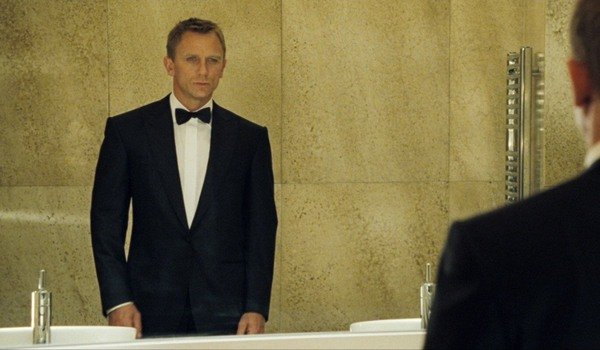
We begin with Bond at the beginning of his career, receiving his 007 status by killing a traitorous section chief named Dryden (Malcom Sinclair) and his contact Fisher (Darwin Shaw). Bond kills Fisher brutally in a bathroom and wastes no time with Dryden who, in a blink-and-you’ll-miss-it shot, has a picture of his family on his desk. James Bond just killed a family man – that’s certainly a new one.
Bond goes on the trail of a bomb maker in Madagascar, then an associate in Nassau and before you know it he’s stopped an attempted bombing at Miami airport. He clearly gets results but his methods are disapproved of by his superior M (Judi Dench) who tries to keep him grounded but it’s obvious how well that’s going to work.
All of this leads to Bond going to Casino Royale in Montenegro to play poker against a known terrorist financier named Le Chiffre (Mads Mikkelsen), who is desperate to earn back money he has lost from some people who are not the easily forgiving type. Bond is aided in his mission by treasury official Vesper Lynd (Eva Green) with whom he has some minor disagreement but generally gets along with very well. All Bond has to do is beat Le Chiffre at poker and get him into the hands of the authorities, which may be easier said than done.
I know many people were sceptical of Craig’s ability to inhabit the character of Bond. I can only imagine how embarrassed they felt once all the positive reviews of the film started pouring in, many of them praising Craig’s performance. He’s as far from Brosnan’s Bond as it’s possible to be. He’s cold, efficient but very much human and is given small touches that help him to stand out from his predecessors. For instance, after surviving a fight that left him covered in blood, where Brosnan’s Bond would just get on with it, Craig’s goes to a sink and washes it all off, wincing as he does it.
Eva Green makes a lasting impression as the first Bond Girl of this new era and has great chemistry with Craig. Unlike many other Bond Girls who seem to fall in love with him instantly, it takes a while for the two of them to get to that place in their relationship. This brings us to another moment where Vesper is sitting under a shower and freaking out because she has just killed someone. Bond sits down with her and comforts her. That’s something that you would never see any of the other Bonds doing.
On to Mads Mikkelsen as Le Chiffre: he doesn’t have a volcano lair or a plan to blow up the world, instead he’s easily disposable and he knows it. He has presence, charm and an odd sense of desperation, especially in one particular scene that I will not go into detail about, but anyone who’s seen the film will know what I’m talking about. It’s refreshing to see a villain who is less of an over-the-top caricature and more of a human being.
Neal Purvis, Robert Wade and Paul Haggis had the task of creating a story worthy of the reboot that would hopefully open new doors and opportunities for the franchise. As far as I’m concerned, they succeeded. I’m not sure if I would credit this to the writers or to Martin Campbell’s direction, but the beginning features a lengthy parkour chase scene which despite its length never becomes boring. There are some small touches to convey that this Bond is lacking in the experience that some of his enemies have. For instance, the man he’s chasing in Madagascar is more than capable of parkour and jumping from a high rooftop onto a crane, but when Bond tries it he more or less crashes on it; and when the parkour expert jumps through a small window with no door in sight, Bond has no choice but to burst through a wall.
Another key moment to point out is when Bond is seducing a woman to get information out of her about her husband. They are making out and any Bond fan can see from miles off where it’s going… but it doesn’t. He gets the information he needs, orders a bottle of champagne and leaves, once again demonstrating that this is far from the James Bond the audience have come to expect.
Structurally the film is split into three acts. The first two have a lot of action with the first seeing Bond doing a lot of investigating. The second takes place mostly in Montenegro at the Casino and when there’s action, its gritty, visceral, and with not a trace of camp humour in sight. Act Three is more character-focused with the relationship between Bond and Vesper taking up a fair bit of screentime – this is fine, but anyone who’s read the book will know how it’s all going to end. There have been some changes from the novel, but mostly minor ones and the fans who also love the books can be assured that this film is faithful to the original, even going as far as to include its most iconic scene.
David Arnold is back to compose the score, but when it comes to Casino Royale and its music I can only think of the theme song You Know My Name by Chris Cornell who of course is sadly no longer with us, but his song definitely helps with the contemporary feel this new film was trying to create.
Not everything is perfect – I do wish that the poker scenes were cut down a little. Given that the film is two hours and fourteen minutes long, if you cut in the right places it would have made quite an exceptional two-hour film. But that’s just my opinion and others seem to be okay with it.
Casino Royale very successfully brought James Bond into the 21st century with a realistic, gritty tone and a new Bond who stays close to Ian Fleming’s original vision. I think that after seeing this, many people felt that the damage done by Die Another Day had been more or less repaired and I would have to agree. This was certainly a good direction for the franchise at that moment in history and I only hope that Daniel Craig will leave the role of James Bond with as much of a bang as when he entered it.